
The current narrative around generative media suggests that the “perfect prompt” is the holy grail of production. If you can just string together the right sequence of adjectives and technical jargon, a polished, high-converting video will emerge from the machine. For performance marketers, however, this promise rarely survives the first round of creative testing.
In a professional setting, a prompt is just a suggestion. When you are iterating on ad creatives at scale, the unpredictability of a raw text-to-video workflow is a liability, not a feature. The goal of a performance pipeline is reliability—the ability to produce ten variations of a winning hook without drifting away from brand guidelines or falling into the uncanny valley.
The most effective teams have stopped trying to “out-prompt” the model. Instead, they are moving toward a workflow centered on asset seeding. This approach uses structural constraints and existing brand assets to guide an AI Video Generator toward a predictable result. It turns the process from a creative lottery into a repeatable engineering task.
The Efficiency Trap: Why Text Prompts Fail the Performance Test
The fundamental problem with “cold” prompting—starting from a blank text box—is the high variance of the output. If you ask a model for a “woman drinking coffee in a sunlit kitchen,” you might get a masterpiece on the first try, or you might get a flickering mess where the coffee cup merges with the character’s hand.
For a performance marketer, this variance creates a massive “editor’s debt.” You spend more time discarding unusable clips and attempting to “fix it in post” than you would have spent in a traditional production cycle. Text is inherently ambiguous; terms like “cinematic lighting” or “dynamic motion” are interpreted differently by every underlying model, from Sora to Kling.
Furthermore, raw prompting often fails the brand consistency test. Performance marketing relies on the audience recognizing a product or a persona across multiple touchpoints. A text prompt alone struggles to maintain the exact facial features of a talent or the specific shade of a product’s packaging across five different video variations. Without a visual anchor, you are essentially asking the AI to reinvent your brand every time you hit “generate.” This lack of structural constraint is why so many AI-generated ads feel “off”—they lack the commercial reliability required for high-spend campaigns.
Asset Seeding: Anchoring the AI Video Generator in Brand Reality
The shift from text-to-video to image-to-video (I2V) is where the real scaling happens. Asset seeding involves providing the model with a “seed frame”—a high-fidelity image that contains the exact composition, lighting, and character details you need.
By starting with a static image, you eliminate 90% of the creative guesswork. If you have an image ad that is already performing well on Meta or TikTok, that image becomes the blueprint. You aren’t asking the AI to imagine a scene; you are asking it to animate a reality that already exists.
Within the MakeShot ecosystem, this workflow is streamlined through tools like Nano Banana. Instead of jumping straight into motion, an operator can use the Nano Banana AI image maker to perfect the “hero frame” first. You can iterate on the product placement, the color grading, and the talent’s expression in a static environment where control is absolute. Once the seed image is locked, it is fed into the AI Video Generator as a reference.
This method drastically reduces compute waste. Because the model is constrained by the pixel data of the seed image, the resulting motion is far more likely to maintain character consistency and object permanence. You are no longer fighting the model’s imagination; you are directing its kinetic energy.
The Iteration Loop: A Systems-Minded Workflow for Ad Creatives
Scaling video production requires a move away from “one-and-done” generation. A professional workflow should look less like a creative session and more like an assembly line, built on three specific phases.
Phase 1: Defining the Motion Vector
Before generating a full-res clip, you must define the specific action that drives the conversion. Is it a product reveal? A reaction shot? In this phase, the prompt is used strictly to describe *movement*, not the scene itself. Since the seed image already defines the “what,” the prompt only needs to handle the “how.” For example, “slow zoom into the product” or “subject smiles and nods.”
Phase 2: The Low-Fidelity Preview Loop
One of the biggest mistakes teams make is rendering every idea at maximum resolution. This is a waste of time and credits. A more efficient loop involves generating low-resolution “proofs” to test physics and lighting. This is the moment for an expectation reset: not every motion sequence will work. If the physics of a liquid pour look unnatural in a low-res preview, it won’t get better in 4K. Catching these errors early allows you to adjust the motion prompt or change the seed image before committing to a final render.
Phase 3: Multi-Model Verification
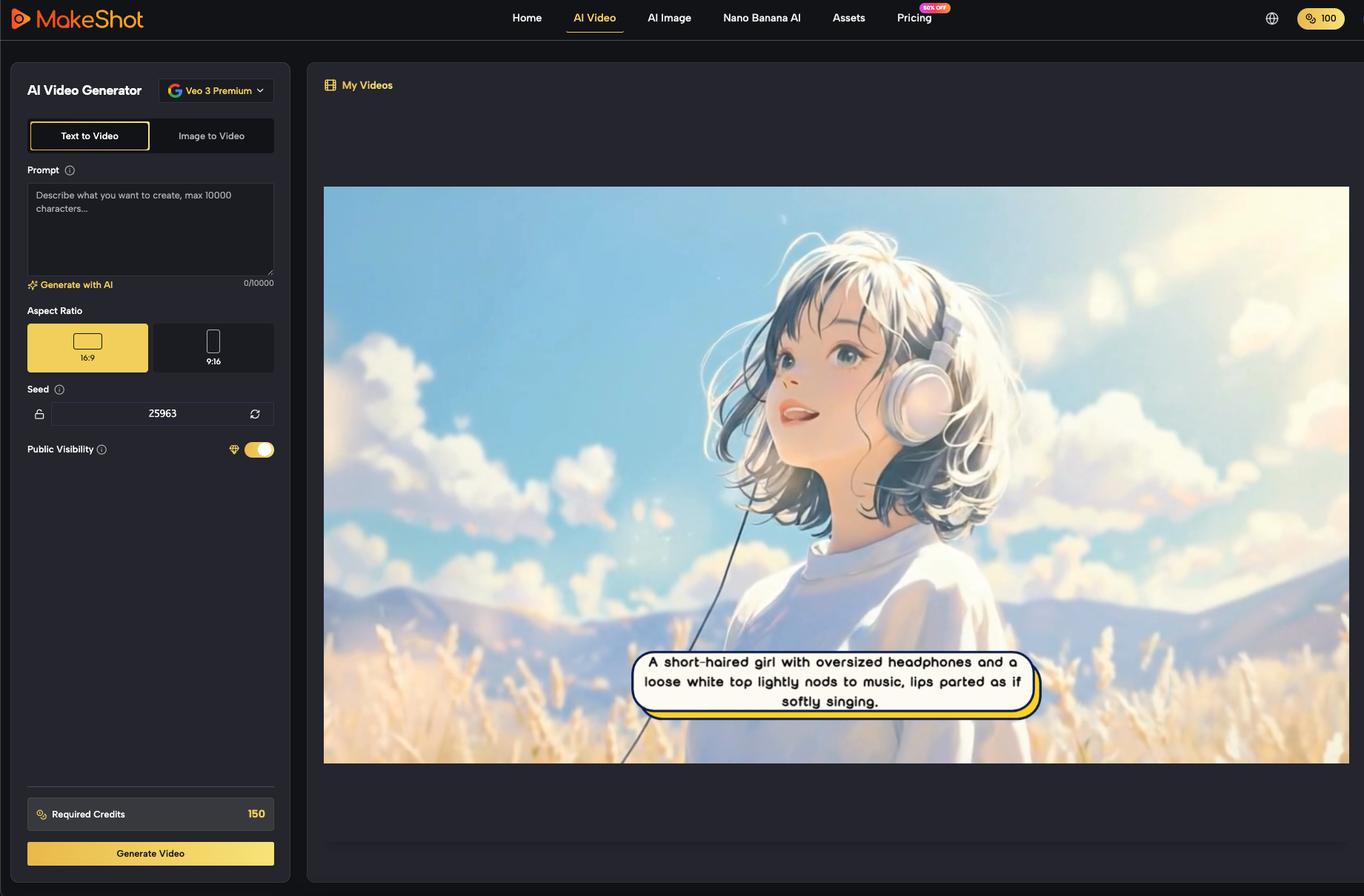
Different AI models have different “personalities.” Some are better at fluid human movement, while others excel at environmental textures or atmospheric lighting. Using the AI Video Generator platform, operators can test the same seed frame across multiple engines—such as Google Veo or Sora—to see which one handles the specific motion vector best. This multi-model approach ensures that you aren’t limited by the technical quirks of a single provider.
Technical Uncertainty and the Limits of Generative Physics
While the technology has progressed rapidly, we must be honest about the current ceiling. We are still in an era of “generative approximation.” The “uncanny valley” remains a significant hurdle, particularly in complex human interactions.
For instance, any motion involving high levels of occlusion—where one object passes behind another, like a hand moving behind a glass—still sees a failure rate near 40% in many models. Objects may morph, or fingers may multiply. As an operator, you have to know when to lean into the AI and when to pull back. Simple pans, tilts, and basic facial animations are currently reliable; complex choreography or intricate mechanical movements often require manual masking or traditional VFX intervention to reach a professional standard.
There is also a persistent uncertainty regarding temporal flickering. While newer models have improved frame-to-frame consistency, it is currently impossible to predict exactly which model update will “solve” physics glitches for good. Marketers must build their workflows around these limitations rather than assuming the AI will eventually figure it out on its own. If a clip flickers, the most practical move is often to change the motion vector entirely rather than re-rolling the same prompt ten times.
Commercial Gains: Reducing the Per-Creative Cost of Variation
The ultimate goal of this systematic approach is to drive down the effective cost of creative testing. In the traditional world, producing ten variations of a video ad meant ten different shoots or ten long sessions in an edit suite. In an AI-driven workflow, the primary costs shift from “production” to “compute and curation.”
By using an AI Video Generator as a refinement engine rather than a magic wand, agencies and brands can multiply their creative output without a linear increase in headcount. One creative lead can oversee the generation of dozens of hooks, provided the pipeline is anchored in high-quality source assets.
Platforms like MakeShot facilitate this by unifying the disparate parts of the process—image creation, upscaling, and multi-model video generation—into a single interface. This reduces the friction of moving between different specialized tools, allowing the marketer to focus on the performance data rather than the technical plumbing.
The winners in the next phase of AI-driven marketing won’t be the people who write the longest prompts. They will be the ones who build the most robust loops—marketers who understand that the “shot” is only the beginning, and the real value lies in the systematic refinement of the image through motion. Successful video at scale isn’t about capturing lightning in a bottle; it’s about building a better bottle.
